
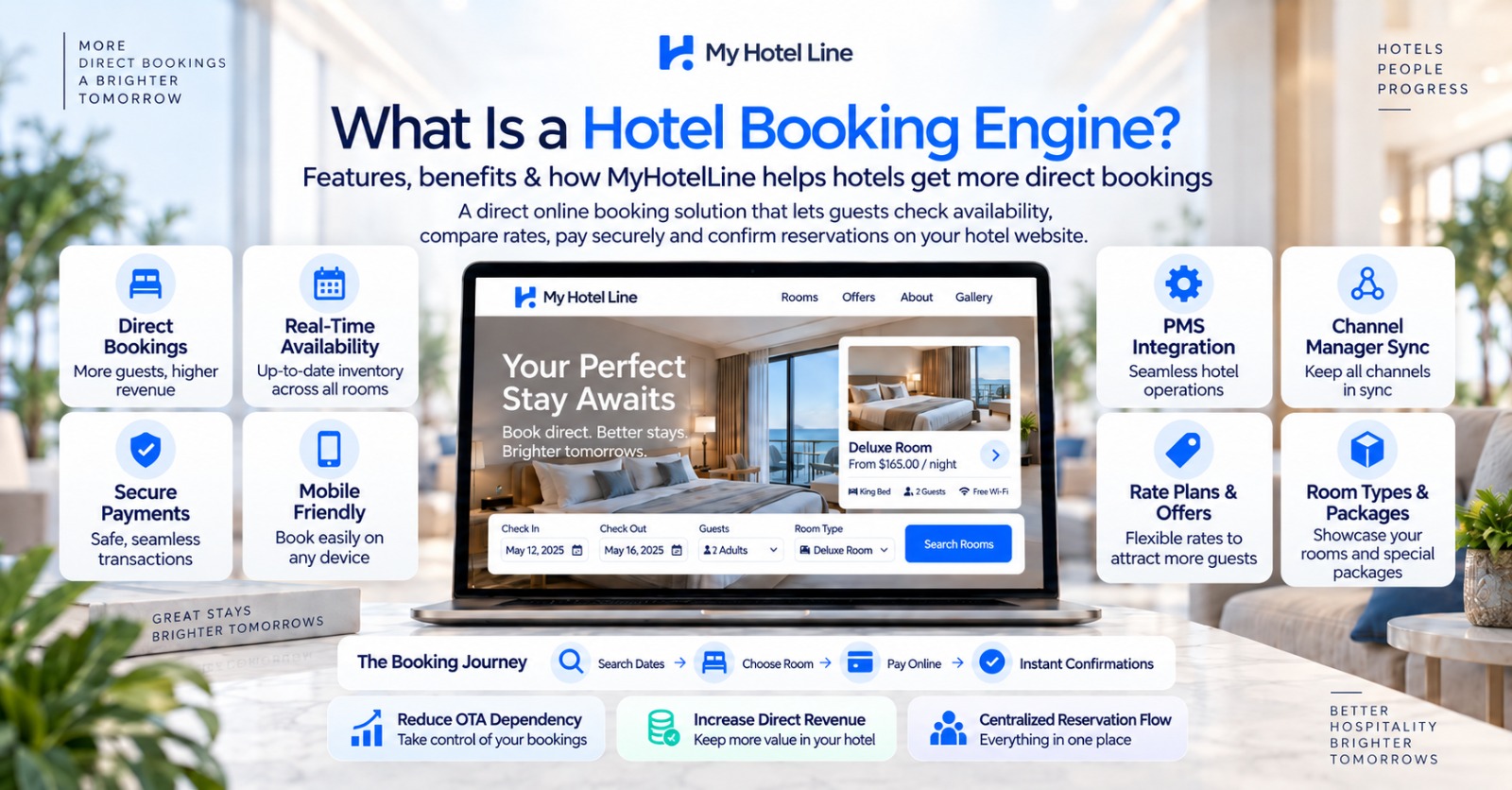
What Is a Hotel Booking Engine? Features, Benefits & How MyHotelLine Helps Hotels Get More Direct Bookings
A hotel booking engine is software that allows guests to check room availability, view available rates, select a room, enter their details, make an online payment and complete a reservation directly through a hotel's website. Instead of sending potential guests to a third-party Online Travel Agency (OTA), a booking engine gives hotels their own digital reservation channel where guests can book rooms directly. For modern hotels, resorts, boutique properties and independent accommodations, a hotel booking engine has become an important part of their online sales and reservation strategy.
For a hotel, the purpose of a booking engine is not simply to accept reservations. It also helps create a smooth digital booking experience that can turn website visitors into paying guests. When a guest searches for dates, views room availability, compares rates, selects a room and completes the booking without unnecessary redirects or complicated steps, the hotel has a better opportunity to convert that booking directly. A well-connected booking engine can also send reservation information into the hotel's Property Management System (PMS), helping reduce manual data entry and keeping hotel operations connected with online reservations.
How Does a Hotel Booking Engine Work?
A hotel booking engine generally works by connecting the hotel's website with its reservation and inventory system. When a guest enters their preferred check-in and check-out dates, the booking engine displays the available rooms and applicable rates. The guest can then select a room, review the booking details, choose available add-ons or packages, provide guest information and complete the payment process. Once the reservation is confirmed, the booking information can be transferred to the hotel's PMS so that the property team can manage the reservation from its central system.
For example, when a guest visits a hotel's website and clicks "Book Now," the booking engine can show available room types and rates for the selected dates. After the guest completes the reservation, the booking details are recorded in the hotel's reservation system and the guest can receive a confirmation. When the booking engine, PMS and Channel Manager are properly connected, changes in room availability can also be reflected across the hotel's connected sales channels.
Why Is a Hotel Booking Engine Important?
A hotel booking engine is important because it gives a property a direct online booking channel. Hotels invest in websites, search engine optimization, social media, paid advertising and other digital marketing activities to attract potential guests. However, attracting visitors is only one part of the process. The website also needs to provide a simple and trustworthy way for those visitors to complete their reservation.
Direct bookings can help hotels establish a direct relationship with guests instead of relying entirely on third-party booking platforms. Through their own booking channel, hotels can present their rooms, rates, packages and promotional offers according to their own business strategy. A direct booking experience can also make it easier for hotels to communicate with guests before and after their stay and encourage repeat bookings.
This does not mean that hotels need to stop using OTAs. OTAs can remain valuable sources of visibility and new customers. A more balanced strategy is to use OTAs for distribution and customer acquisition while developing the hotel's own website and booking engine as a strong direct-booking channel.
What Features Should a Hotel Booking Engine Have?
A modern hotel booking engine should provide more than a simple reservation form. It should make it easy for guests to search availability, understand room options, compare rates and complete their booking with minimal friction. Real-time availability and pricing are particularly important because guests expect the information displayed on the website to reflect the hotel's current inventory and rates.
A good booking engine should also support different room types, rate plans, promotional offers and packages. Hotels may want to offer seasonal rates, early-booking discounts, special packages, meal-inclusive plans or direct-booking promotions. Giving guests the ability to see these options during the booking process can make the website more useful as a direct sales channel.
The booking experience should also be mobile-friendly. Many travelers research hotels and make reservations using smartphones, so a booking engine that works well across mobile, tablet and desktop devices can provide a better guest experience. The booking process should be easy to understand, with clear room information, pricing, policies, guest details and payment steps.
Online payment integration is another important feature. Guests should be able to complete their reservations through convenient and secure payment methods supported by the hotel. A smooth payment process can reduce unnecessary friction between selecting a room and confirming the reservation.
How Does MyHotelLine Help Hotels With Direct Bookings?
MyHotelLine is a hotel management software platform that brings together key hospitality technologies, including Cloud PMS, Hotel Booking Engine, Channel Manager and POS solutions. Its booking engine can serve as the hotel's direct online reservation channel while working as part of a connected hotel-management ecosystem.
With MyHotelLine, hotels can provide website visitors with an online booking journey where they can check availability, select rooms and complete reservations. The booking engine can be connected with the hotel's broader reservation and inventory workflow, helping reduce the need for staff to manually transfer booking information from the website into their hotel system.
The advantage of using connected hotel technology is that the booking engine does not have to operate as an isolated tool. When the booking engine, PMS and Channel Manager work together, information related to reservations and availability can be managed more efficiently. This can help hotels simplify their reservation processes while maintaining better control over their direct and third-party distribution channels.
Hotel Booking Engine vs Hotel PMS
A hotel booking engine and a hotel PMS perform different functions. The booking engine is primarily designed for the guest-facing booking process, allowing travelers to search for rooms and make reservations through the hotel's website. A Property Management System (PMS) is primarily used by hotel staff to manage reservations and other property operations.
The two systems complement each other. The booking engine helps generate and capture online reservations, while the PMS provides the central operational system through which hotel staff can manage those reservations. When both systems are connected, reservation information can move between the guest-facing booking process and the hotel's operational workflow more efficiently.
Hotel Booking Engine vs Channel Manager
A hotel booking engine and a Channel Manager are also different technologies. A booking engine is designed to help hotels generate direct bookings through their own website, while a Channel Manager helps distribute room availability and rates across connected online sales channels such as OTAs.
In simple terms, the booking engine focuses on direct bookings, the Channel Manager focuses on online distribution, and the PMS focuses on hotel reservation and property operations. When these systems are connected, hotels can create a more centralized approach to managing reservations and inventory.
How Do Booking Engine, PMS and Channel Manager Work Together?
The real value of a hotel booking engine becomes clearer when it is connected with a PMS and Channel Manager. Consider a hotel that receives a reservation through its website. The booking engine captures the guest's reservation, while the PMS can receive the booking information for operational management. The hotel's inventory can then be updated according to the connected system configuration, while the Channel Manager can help distribute updated availability to connected online channels.
This connected approach can reduce repetitive manual work and help hotels maintain more consistent availability across different booking sources. It can also make it easier for hotel staff to manage reservations from a central system rather than checking and updating multiple platforms separately.
How Can a Hotel Booking Engine Help Increase Direct Bookings?
A booking engine can contribute to direct-booking growth by making it easier for website visitors to move from researching a property to completing a reservation. However, the booking engine should be considered part of a larger digital marketing strategy rather than a standalone solution.
Hotels can combine their booking engine with SEO, Google Business Profile optimization, paid search campaigns, social media marketing, remarketing, email marketing and other digital channels to attract potential guests to their website. Once visitors arrive, a simple booking process, clear pricing, attractive room information and convenient payment options can help turn that traffic into reservations.
Hotels can also use their direct booking channel to promote exclusive offers, packages and promotional rates. These incentives can give guests an additional reason to complete their reservation directly with the property.
Hotel Booking Engine for Small Hotels
A hotel booking engine can be particularly useful for small and independent hotels that want to accept reservations directly through their own websites. Smaller properties may have limited staff and therefore benefit from a booking process that reduces manual reservation work and allows guests to make bookings without contacting the property directly.
For small hotels, an effective booking engine should be easy to manage, mobile-friendly, connected to the hotel's PMS and capable of working with the property's distribution strategy. MyHotelLine can provide a connected technology approach by bringing the Booking Engine together with Cloud PMS and Channel Manager functionality.
Hotel Booking Engine for Resorts
Resorts can have more complex reservation requirements because they may offer multiple room categories, packages, meal plans, seasonal offers and additional services. A booking engine for a resort should therefore provide a clear booking experience that allows guests to understand their accommodation options and select the most suitable rate or package.
By connecting the booking engine with the hotel's broader management system, resorts can manage online reservations alongside their regular hotel operations. This can be particularly useful for properties that receive bookings through their website as well as multiple online distribution channels.
What Should Hotels Consider When Choosing a Booking Engine?
Hotels should evaluate a booking engine based on more than its ability to accept reservations. The most important considerations include PMS integration, Channel Manager connectivity, real-time availability, rate management, mobile responsiveness, online payment capabilities, promotional offers, reporting and ease of use.
Hotels should also consider whether the booking engine supports their long-term digital strategy. The system should work effectively with the hotel's website and marketing activities and should make it possible to measure the performance of the direct booking channel. A connected solution can also reduce the complexity that comes from managing multiple independent hotel technology systems.
Why Choose MyHotelLine Hotel Booking Engine?
MyHotelLine provides hotels with a connected hotel technology platform that includes Cloud PMS, Booking Engine, Channel Manager and POS. Instead of managing each component as an entirely separate system, hotels can use MyHotelLine to bring important reservation, distribution and operational functions into a more connected environment.
For hotels that want to strengthen their direct booking channel, MyHotelLine provides a way to combine the website booking experience with the hotel's wider reservation and distribution workflow. This can help properties manage direct reservations, online availability and hotel operations more efficiently while providing guests with a convenient way to book rooms online.
Frequently Asked Questions About Hotel Booking Engines
What is a hotel booking engine?
A hotel booking engine is software that allows guests to check room availability, view rates, select rooms, enter their information, make payments and complete reservations directly through a hotel's website.
Why do hotels need a booking engine?
Hotels use booking engines to provide guests with a direct online reservation channel. A booking engine can help properties generate direct bookings, reduce manual reservation work and provide guests with a convenient way to book rooms online.
Is a hotel booking engine the same as a PMS?
No. A booking engine handles the guest-facing online reservation process, while a PMS is used by hotel staff to manage reservations and property operations. Integrating both systems can create a more connected reservation workflow.
What is the difference between a booking engine and a Channel Manager?
A booking engine helps hotels receive direct reservations through their websites. A Channel Manager helps distribute and synchronize room availability and rates across connected online sales channels.
Can a small hotel use a booking engine?
Yes. Small and independent hotels can use booking engines to accept direct reservations online and provide guests with a convenient alternative to calling or emailing the property.
Can a resort use a hotel booking engine?
Yes. Resorts can use booking engines to sell rooms, rate plans, packages and promotional offers through their websites.
Does MyHotelLine provide a hotel booking engine?
Yes. MyHotelLine provides a Hotel Booking Engine as part of its broader hotel management technology ecosystem, alongside solutions such as Cloud PMS, Channel Manager and POS.
How does MyHotelLine help hotels manage online bookings?
MyHotelLine connects the hotel's booking process with its wider hotel-management ecosystem. This allows properties to manage online reservations alongside PMS and distribution functions rather than relying entirely on disconnected systems.
Can a hotel booking engine help increase direct bookings?
Yes. A well-designed booking engine can make it easier for website visitors to complete reservations directly with the hotel. However, hotels should combine their booking engine with effective SEO, digital marketing, promotions and a user-friendly website to maximize direct-booking opportunities.
Conclusion
A hotel booking engine is no longer simply an online reservation form. It is an important part of a hotel's digital sales and distribution strategy. By allowing guests to check availability, compare rooms and rates, make payments and complete reservations directly through the hotel's website, a booking engine can help properties strengthen their direct booking channel.
The strongest results come when the booking engine works together with other hotel technologies. MyHotelLine combines Hotel Booking Engine, Cloud PMS, Channel Manager and POS capabilities, giving hotels a connected platform for managing reservations, distribution and hotel operations. For hotels looking to build a stronger direct booking strategy while simplifying their technology stack, a connected solution such as MyHotelLine can provide a practical foundation for managing the modern guest booking journey.
We are trusted by over X+ properties in X countries. It’s your turn now!


