
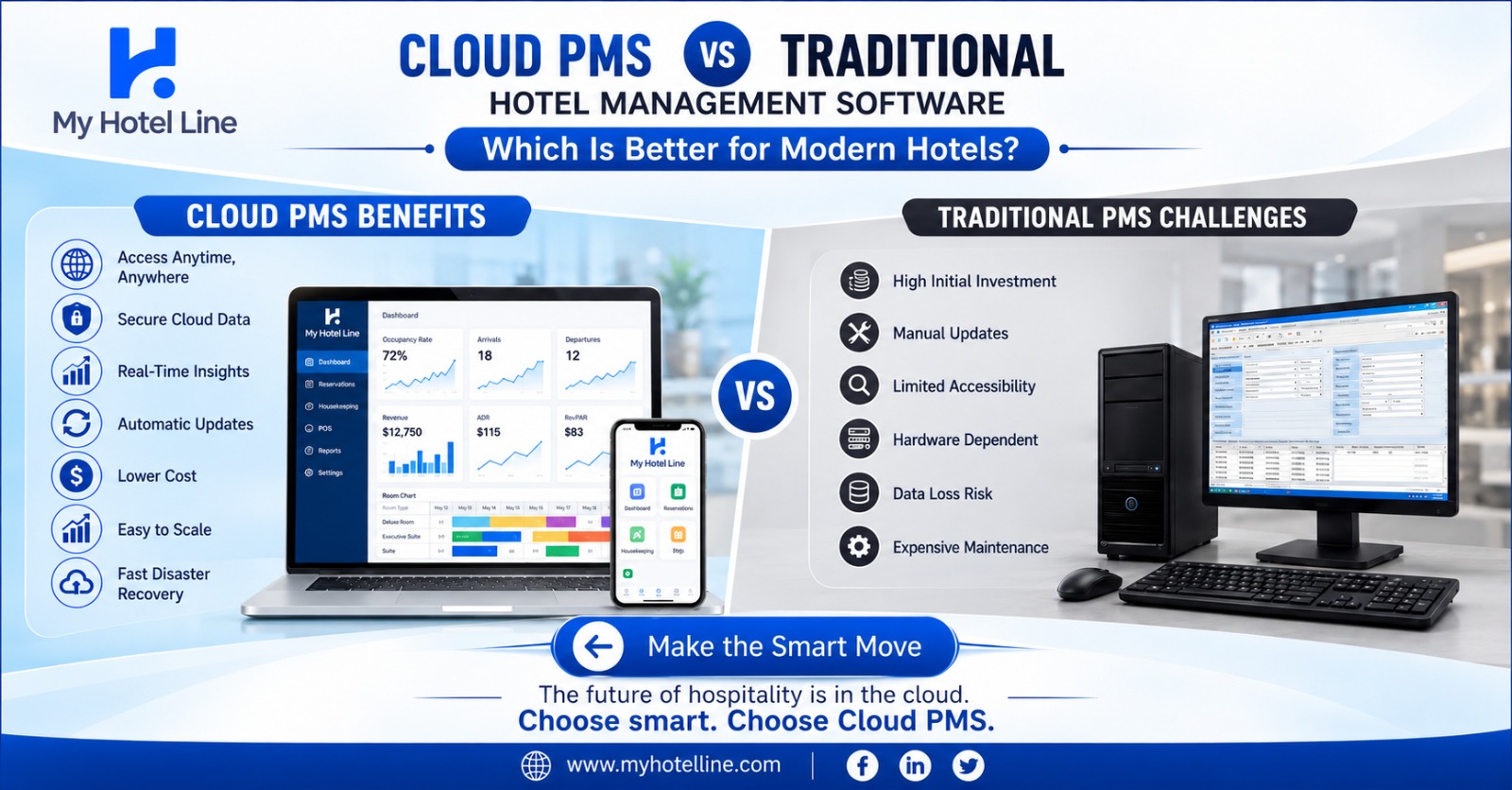
Cloud PMS vs Traditional Hotel Management Software: Which Is Better for Modern Hotels?
Technology has transformed the hospitality industry over the last decade. Guests expect seamless online bookings, contactless check-ins, faster service, and personalized experiences, while hotel owners need real-time business insights and operational efficiency. Choosing the right Property Management System (PMS) has become one of the most important decisions for hotels of every size.
Today, hotels generally choose between Cloud PMS (Cloud-Based Property Management System) and Traditional Hotel Management Software (On-Premise PMS). While both help manage hotel operations, they differ significantly in terms of accessibility, cost, maintenance, scalability, and performance.
This guide compares both solutions to help you determine which is best for your hospitality business.
What is a Cloud PMS?
A Cloud Property Management System (Cloud PMS) is hotel management software hosted on secure cloud servers. Since the software operates online, hotel staff can access it from any device with an internet connection.
Instead of installing software on a local computer or server, all hotel data—including reservations, guest profiles, billing, room availability, housekeeping status, and reports—is securely stored in the cloud.
Solutions like MyHotelLine Cloud Hotel Management Software allow hoteliers to manage their entire business remotely while benefiting from automatic updates, enhanced security, and real-time synchronization.
What is Traditional Hotel Management Software?
Traditional hotel management software, also known as an On-Premise PMS, is installed on computers or servers located within the hotel property.
The hotel is responsible for maintaining servers, installing software updates, performing backups, securing data, and troubleshooting technical issues. Access is generally limited to the hotel's local network unless additional remote-access infrastructure is configured.
Although many hotels have relied on traditional PMS systems for years, they often require higher maintenance and provide less flexibility compared to cloud-based solutions.
Cloud PMS vs Traditional Hotel Management Software
When comparing a Cloud Property Management System (Cloud PMS) with traditional hotel management software, the differences become clear in terms of flexibility, cost, and efficiency. A Cloud PMS is web-based, allowing hotel staff to access the system from anywhere at any time using an internet connection, while traditional PMS software is typically installed on a local server and is mostly accessible only on-site. Cloud PMS solutions require a lower initial investment because there is no need for expensive server hardware, whereas traditional systems often involve significant upfront costs for infrastructure and installation.
Maintenance is another major advantage of Cloud PMS, as software updates are performed automatically by the provider, ensuring hotels always have access to the latest features and security improvements. In contrast, traditional hotel management software requires manual updates, which can be time-consuming and may lead to additional maintenance expenses. Cloud PMS also provides automatic cloud backups, reducing the risk of data loss, while traditional systems depend on manual backup processes that require regular monitoring.
From a security perspective, Cloud PMS platforms typically offer enterprise-grade cloud security with advanced encryption, continuous monitoring, and regular updates. Traditional systems rely heavily on the hotel's local IT infrastructure, making security dependent on the quality of in-house maintenance. Cloud PMS is also highly scalable, allowing hotels to add users, properties, or new features without investing in additional hardware. Traditional PMS often requires costly hardware upgrades and complex system configurations to accommodate business growth.
For hotel groups managing multiple properties, Cloud PMS includes built-in multi-property management capabilities, enabling centralized operations across locations. Traditional PMS solutions frequently require additional setup or separate modules to achieve similar functionality. Mobile accessibility is another key benefit of Cloud PMS, allowing hotel owners and managers to monitor operations, reservations, and reports from smartphones or tablets, whereas traditional systems usually provide limited or no mobile access. Finally, Cloud PMS offers faster disaster recovery because data is securely stored in the cloud and can be restored quickly. Traditional hotel management software relies on local backup systems, making recovery slower and more vulnerable in the event of hardware failures or unforeseen disasters.
1. Accessibility
One of the biggest advantages of Cloud PMS is accessibility.
Hotel owners, managers, and staff can monitor operations from anywhere using a laptop, tablet, or smartphone.
Whether you're traveling, working remotely, or managing multiple properties, real-time information is always available.
Traditional PMS generally restricts access to computers located within the hotel unless complex remote access systems are installed.
Winner: Cloud PMS
2. Lower Initial Investment
Traditional hotel software often requires:
- Dedicated servers
- Networking equipment
- IT infrastructure
- Installation costs
- Software licenses
Cloud PMS eliminates most of these expenses because everything is hosted online.
Hotels typically pay a predictable monthly or annual subscription, making budgeting much easier.
Winner: Cloud PMS
3. Automatic Software Updates
Technology evolves quickly, and hotels need software that stays current.
Cloud PMS providers automatically release:
- Security updates
- Feature enhancements
- Performance improvements
- Regulatory updates
Traditional software often requires manual installation, resulting in downtime and additional IT expenses.
Winner: Cloud PMS
4. Better Data Security
Security is critical because hotels store sensitive guest information.
Modern Cloud PMS platforms use:
- Encrypted databases
- Secure cloud hosting
- Regular backups
- Role-based access
- Multi-layer security protocols
Traditional systems depend heavily on local server security and internal IT practices. Hardware failures or poor backup processes can increase the risk of data loss.
Winner: Cloud PMS
5. Multi-Property Management
If you manage multiple hotels, Cloud PMS makes operations significantly easier.
Managers can:
- Monitor all properties from one dashboard
- Compare occupancy rates
- View consolidated reports
- Manage staff permissions
- Standardize operations
Traditional PMS often requires separate servers and additional configuration for each property.
Winner: Cloud PMS
6. Real-Time Reporting
Cloud PMS provides live dashboards showing:
- Occupancy
- Revenue
- ADR (Average Daily Rate)
- RevPAR (Revenue Per Available Room)
- Booking sources
- Guest statistics
- Housekeeping status
These reports help hotel managers make informed decisions quickly.
Traditional systems may require manual report generation or delayed synchronization.
Winner: Cloud PMS
7. Online Booking Integration
Modern hotels depend heavily on online bookings.
Cloud PMS easily integrates with:
- Booking Engine
- Channel Manager
- OTAs
- Payment gateways
- Revenue management tools
This keeps room inventory synchronized and helps prevent overbookings.
Traditional PMS integrations are often more complex and may require additional software.
Winner: Cloud PMS
8. Scalability
As hotels grow, their software should grow with them.
Cloud PMS allows hotels to:
- Add more rooms
- Open new properties
- Increase users
- Activate new modules
- Expand operations without major hardware investments
Traditional software typically requires purchasing additional servers and infrastructure.
Winner: Cloud PMS
9. Disaster Recovery
Unexpected events such as hardware failures, power outages, or natural disasters can disrupt hotel operations.
Cloud PMS platforms automatically back up data across secure servers, allowing businesses to recover quickly and continue operations with minimal downtime.
Traditional systems rely on local backups, which may be vulnerable if not managed properly.
Winner: Cloud PMS
10. Total Cost of Ownership
While traditional software may appear to be a one-time investment, ongoing costs can add up over time.
These may include:
- Server maintenance
- IT support
- Hardware replacement
- Software upgrades
- Backup solutions
- Security management
Cloud PMS typically offers predictable subscription pricing that includes updates, hosting, backups, and support, making long-term costs easier to manage.
Winner: Cloud PMS
Why Modern Hotels Prefer Cloud PMS
Hotels across the world are increasingly adopting cloud-based solutions because they provide:
- Greater operational flexibility
- Lower infrastructure costs
- Faster software updates
- Better collaboration between departments
- Improved guest experiences
- Secure cloud storage
- Business continuity
- Easy remote management
For independent hotels, resorts, boutique properties, hostels, guest houses, and hotel chains, Cloud PMS offers the agility needed to compete in today's digital hospitality landscape.
Why Choose MyHotelLine Cloud PMS?
MyHotelLine is a comprehensive cloud hotel management software built to simplify hotel operations and support business growth. Designed for hotels of all sizes, it combines powerful automation with an intuitive interface.
Key Features
- Cloud-Based Hotel Property Management System (PMS)
- Central Reservation System (CRS)
- Online Booking Engine
- Channel Manager Integration
- Front Office Management
- Housekeeping Management
- Point of Sale (POS)
- Guest Relationship Management (CRM)
- Revenue Management Tools
- Multi-Property Management
- Mobile-Friendly Dashboard
- Real-Time Reports & Analytics
- Secure Cloud Backup
- Automated Billing & Invoicing
- 24×7 Customer Support
Whether you manage a single hotel or multiple properties, MyHotelLine helps streamline operations, reduce manual work, improve occupancy, and deliver exceptional guest experiences.
Final Thoughts
The hospitality industry is becoming more connected, mobile, and data-driven. While traditional hotel management software served hotels well in the past, modern business demands require greater flexibility, scalability, and real-time access.
A Cloud PMS provides everything today's hoteliers need—from remote accessibility and automatic updates to secure data management and seamless integrations. It enables hotels to operate more efficiently, improve guest satisfaction, and make smarter business decisions based on real-time insights.
Planning to upgrade your hotel technology, investing in a cloud-based solution like MyHotelLine can help future-proof your operations and position your business for long-term success in an increasingly competitive hospitality market.
We are trusted by over X+ properties in X countries. It’s your turn now!


